 ®
®

Solving Problems with Algorithms-Ace Dan Zingaro
Submitted by No Starch Press on Tue, 2023-05-23 12:02
 Our latest Author Spotlight is on computer-science whiz Daniel Zingaro, author of Algorithmic Thinking as well as its soon-to-be published second edition, and Learn to Code by Solving Problems (2021). In the following Q&A, we talk with Dan about his favorite childhood computing memory, how he went from nearly dropping out of CS classes at university to teaching them, the accessibility tools that helped him become a programmer despite being severely visually impaired, and why fellow educators should feel empowered to write books about the subjects they teach.
 Daniel Zingaro, PhD, is an award-winning associate professor of Mathematical and Computational Sciences at the University of Toronto Mississauga, where he is well-known for his uniquely interactive approach to teaching, and internationally recognized for his expertise in Active Learning. In addition to writing, educating, and researching, Zingaro is one of our go-to technical editors, whose work includes Python for Kids, 2nd Edition (2022), Data Structures the Fun Way (2022), Python for Data Science (2022), and Python One-Liners (2020).
No Starch Press: Congratulations on the second edition of Algorithmic Thinking! One of the things that really makes it unique is your show-not-tell approach to teaching algorithms, where you present the problem first and then guide the reader toward finding the fastest, cleverest solution. It can’t be a coincidence that you’re also an award-winning college professor known for your “active learning” method. Did your experience as an educator influence the way you wrote the book?
Daniel Zingaro: Oh, definitely. I've learned so much about teaching from my students, and I always try to incorporate as much of that as I can into my writing. The reason I flipped the book to be "problem first, material second," rather than the opposite, is because many people are not motivated to learn abstract stuff without understanding why it might be useful or matter to them. If I can have a reader read a description of a problem and be like, "Yo! I don't know how to solve this thing," then I feel like the real learning can begin.
I've also tried to make the book inviting to students who might otherwise not feel welcome. For example, I didn't put proofs or theorems or much math in there, because I know what that stuff does to many students: "Theorem 1: let x, y, and z be ... oh hey look, a new YouTube video!" So why force students to learn in a specific way? Because we happened to learn that way? Because that's the only way to teach it? Those reasons aren't acceptable to me. Students provide constraints on how they want to learn. If we professors are all we think we're cracked up to be, let's rise to this challenge and teach under those constraints. There's no right way to teach. If someone (like, literally, I mean one person) learns from it, then it is right.
NSP: It’s hard to believe that you twice came close to dropping out of Computer Science while attending university — and nearly failed a course that you later went on to teach. But it must be true because you disclose this personal trivia to your students. Why is it important for you to be so open about your past struggles?
DZ: It's true! I really need to dig out my old transcript and post it online for students so they can see my nearly failed grade. It's very important to me to share these low points with students because many students experience low points of their own. The way I connect with the world is through humor and making personal connections. If there's anything I can share with people that helps me make these connections, then I will do it.
My waffling on whether to drop out of Computer Science, and suffering some poor grades, offer ways for me to make these connections. How funny, right? A professor that almost failed a course? It's really too bad that it's funny – I mean, the only reason it's funny is because it's so rare. With the poor grades and other challenges, I'm fortunate to have still gotten here. But I did, somehow. I figure that maybe my struggles can somehow help someone else with their own struggles.
NSP: Let’s talk about accessible computing for a moment. A lot of our readers may be surprised to learn that you’ve been blind your entire life, which would put you in the very small category of visually impaired students who successfully learn programming and earn advanced degrees in the subject. What adaptive tools helped you overcome the challenges you faced? And, how has the level of accessibility in computing evolved?
DZ: Yep – that's why my books don't have any extraneous pictures. Or cute sidebars. Or cute icons.
The computing tools for accessibility these days are making huge advances. I use the free NVDA screen-reader to do all of my computing tasks. But looking back, the tools only helped me because my parents gave me the opportunity for the tools to help me. My parents are in the Acknowledgements section of my book because, without them, there is no book, there is no career, there is no who-knows-what-else. If you have a disability or are otherwise being excluded, then (if it's safe to do so): advocate for yourself. That's what I learned from them. Could I have advocated for myself otherwise? Could I have advocated if I didn't feel safe in Canada doing so? Probably not. That's scary. I may have worked hard, but the world gave me the opportunity for my work to mean something. How many people work even harder and never have the opportunity to benefit? That's a tragedy.
I try to use one of my lectures every year to show my students the tools that I use to teach. They're computer scientists and are going to be building tools that all of us will use in the future, so I like to show them how much accessibility matters, for real, to a real person. And I always start with a 10-minute discussion of how I hope they interpret what I'm about to show them. It seems natural for them to hear my super-fast screen-reader speech, or the handheld device I use to read Braille, and be like, "holy cow, Dan is epic!" But I'm not. The tools are epic. Actually, wait; that's not quite it. We're all epic. Many people can read or write or do amazing things. And, yeah, the way that most (non-visually impaired) people do it is different than how I do it – but at the end of the day, the technology exists and makes it so that I can do it, too.
Also, a big shout-out to everyone who cares about accessibility and/or works to make software or processes or the world in general more accessible. We need people (including ourselves) to encourage us, and we need the accessibility tools to realize that encouragement.
NSP: Another thing our readers might not know about you is that you're the technical editor behind some of our bestselling books, including Data Structures the Fun Way and the new edition of Python for Kids. Since you've already made a name for yourself as a writer, what drew you to the unsung-hero role of technical editing, and can you tell us a little about what you actually do in that regard?
DZ: I find technical editing to be quite fun. I find learning fun, and editing books helps me sharpen what I know about a particular topic, so it's kind of fun by default. I also welcome the opportunity to help authors produce even better books. It's the best when there's an author doing great work, and I can in some small way help that author even further. Sometimes I'll be editing a book and think, "dang, this is so good! Why couldn't I have written this?" But, the reason is that I couldn't write their book even if I tried. The author has a particular voice, a particular expertise. Editing permits me to revel in that expertise, to just be grateful for the fact that here we have another author who has the ability and opportunity and life circumstances to share what they know.
What I do when editing is annoy the author with every tiny improvement/possible improvement that I can think of. (No, really – ask them.) I check all of the code and text, of course, but that's not my favorite part. My favorite part is using what I know about teaching to offer suggestions where I suspect learners may get particularly stuck. A lot of the topics covered in these books are ones I haven't taught before, and even if I have, I know only a small amount about where and why learners do or do not make progress. The challenge really never goes away, that's for sure, but I welcome any opportunity to try my best to be helpful given what I do know.
NSP: Like many of our authors, you’ve been into programming since you were young. What’s your earliest memory of enjoying computing, and when did it go from being a hobby to a career path?
DZ: One of my earliest computing memories also happens to be one of my favorites. My family was trying to get me a computer loaned to us with screen-reading technology on it (as it was expensive in those days and involved several interacting software and hardware devices). We were at an assessment center to look at some models, and my dad and some employees were talking about computery stuff that I didn't understand. Honestly, all I wanted to do was play a computer game or type something funny on the screen, but the adults just kept talking. Finally they stopped and wanted me to try out three different types of computers to see which one I could best work with. I started with the first computer, typing a little story. And then I managed to do what turned out to be the best thing ever: I froze the machine. But not just a normal freeze, a hilarious freeze where the screen-reader thing kept repeating the same “ah ah ah” syllable again and again, with no way to stop it. All of the fancy computery people were trying fancy things but simply could not make it stop. I was doing my absolute best not to laugh, because I desperately wanted the chance to take home a computer that day. Eventually they gave up and had to completely shut it down by flicking the power switch. Once they did that, I just couldn't hold it in anymore and burst out laughing (while also realizing I probably blew my chance at getting them to give me a PC). But, no! It turns out that they were actually impressed that I had successfully frozen the computer, and agreed to loan it to us on the spot. Looking back, I didn't do anything impressive – probably just pressed a bunch of keys at the same time or some such nonsense.
Presently, I'd say I'm more of a teacher-person than a computer-person. Computing happens to be the thing that I can apparently teach best, but I get my true motivation from teaching in and of itself. I often catch myself learning something new and then immediately thinking about how I might teach it. Or I'll solve a computing problem and then be thinking about which chapter of a book it might serve as an example in.
NSP: You’ve been a professor at UT-Mississauga for nearly a decade now. What’s the most significant thing you’ve discovered about teaching Computer Science in all that time?
DZ: The most significant thing I've learned is that every book is total junk for a subset of students. For any one of the textbooks I use – say, a classic CS book – there is a subset of students for whom that book just doesn't work. In fact, my happiest teaching days usually involve a student telling me that my book isn't working for them. Now, it might not be their happiest day, because then I try to drag them into a two-hour conversation about why it isn’t working. But I really do want to learn from them and try to do better. And they know how passionate I am about learning, so I don't feel too bad about that!
NSP: Much like sky-diving, writing a book takes a leap of faith — and you’ve done both. What advice can you offer to fellow CS educators who have thought about becoming an author but are scared to make the jump?
DZ: I'm married now, and I'm pretty sure I signed some wedding papers that make me not allowed to skydive anymore. (I'm guessing that book-writing is still okay, though.)
I think CS educators are in a unique position to write books that teach. They have so much experience in the classroom, and I myself was surprised how much of it I was able to carry over into my writing. I'm not an algorithms researcher. I don't know a whole lot more about algorithms than what I put into the book. (You'll know that I learned new algorithm stuff if you ever see a third edition of Algorithmic Thinking!) But, you know what? I think not being an algorithms researcher was a blessing for this book. I'm not so far removed from remembering how challenging it was for me to learn these concepts the first time. And the approaches I know best are the general (not specialized) ones that are applicable to a wide variety of problems that programmers might run into in the wild. I hope readers can see in every chapter how excited I am to learn even more about algorithms, and I hope that excitement helps fuel their own excitement.
So, say you teach a web programming course. Or an architecture course. You've tuned it. Your students respond well. Who cares if you're not the foremost expert on web programming or architecture? You're a teacher who knows how to connect with students and, as such, your book is valuable.
Ride-Along with Engineer Grady Hillhouse, the Ultimate Road Trip Buddy
Submitted by No Starch Press on Thu, 2023-02-02 08:31
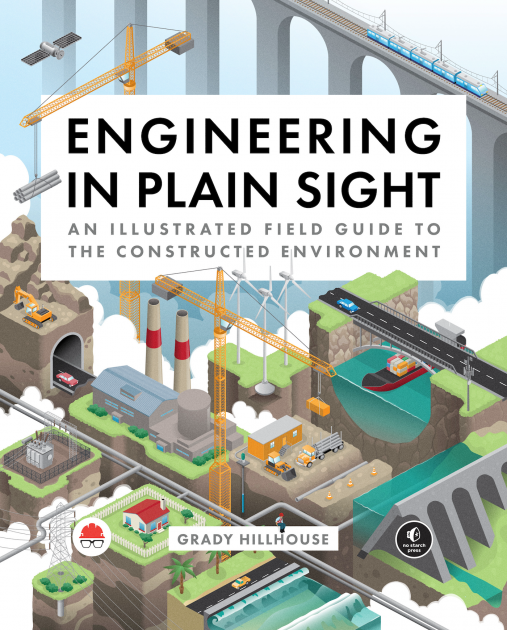 New year, new spotlight—and this one shines on civil engineer and YouTube star Grady Hillhouse. His first book, Engineering in Plain Sight, was released this past Fall to critical acclaim. In the following Q&A, we talk with Grady about how he went from civil engineer to full-time video producer with over 3 million subscribers (hint: woodworking), why all he needed to know about science communication he learned in kindergarten, the importance of average citizens understanding how things work, and the joy of "infrastructure spotting" on the road.
 Grady Hillhouse is a civil engineer and science communicator widely known for his educational video series "Practical Engineering," currently one of the largest engineering channels on YouTube, with millions of views each month. His videos, which focus on infrastructure and the human-made environment, have garnered media attention from around the world and been featured on the Science Channel, Discovery Channel, and in many publications. Before producing videos full- time, Grady worked as an engineering consultant, focusing primarily on dams and hydraulic structures. He holds degrees from Texas State University and Texas A&M University.
No Starch Press: You got your bachelor’s degree in geography, then later earned a master’s degree in civil engineering, and spent nearly a decade working in the field on infrastructure projects. How did you go from that path to becoming a full-time YouTube sensation?
Grady Hillhouse: Making YouTube videos started as a hobby for me when I was given some woodworking tools. I wanted to learn to use them, and of course, I went to YouTube to watch tutorials. What I found was a community of woodworkers producing videos of their projects and sharing with each other. I was so fascinated that YouTube could be used in a social way (I had only thought of it as a search engine for videos), and I wanted to be a part of the community. Over time, I started including some engineering into my woodworking videos. Eventually I realized that I really enjoy sharing my passion and experience in engineering to others, and I decided to focus on that topic.
I continued making videos about engineering and infrastructure in my free time, and worked to make them better and better. When my first son was born, all that free time I had to make videos vanished. I was forced to make a choice between sticking with my career in engineering or finding a way to support my family with my hobby. Ultimately, I decided I could have a bigger impact on the world producing videos (and writing a book). If everything comes crashing down, I still have my engineering license to fall back on!
NSP: You clearly have a genuine passion for the built environment—it shines through in every one of your YouTube videos and all throughout the new book. So, chicken or the egg: Did this interest spring from your graduate studies and (initial) profession, or did your fervor for infrastructure influence your academic and career pursuits?
GH: I have been interested in how things work since I was a kid, but my passion for infrastructure really didn’t come until college. My undergraduate classes in water resources are really what led me into civil engineering. My engineering classes are where my eyes were opened to all the “hidden in plain sight” details of the built environment. Every class was like turning on a lamp to illuminate some innocuous part of the constructed environment that I had never noticed before, and I just never stopped paying attention since.
NSP: Like Bill Nye and Neil deGrasse Tyson, you’re known as a “science communicator.” But one thing engineers are not typically known for is the ability to explain complex technical processes in laypeople's terms. What’s your trick for translating “engineer speak” into engaging, accessible content without dumbing it down?
GH: My wife was a kindergarten teacher when I first started working as an engineer, and I once got invited to her elementary school to give a presentation about civil engineering. I built a model that shows the different purposes of a dam and reservoir. The first presentation I gave went really well. It seemed like the kids were interested in what I had to say, but I noticed that I was getting questions from teachers. So the next few classes, I started paying attention to the teachers and administrators in the back as I went through my presentation, and was surprised at how attentive they were.
It slowly kind of dawned on me over the course of these five or six presentations I gave that, when I talked about my career to adults, I was usually trying to make myself sound smart and dignified, avoid dumbing it down, or accidentally patronizing someone. But, when I was talking to students, I didn’t have those pretenses.
I’ve basically spent the past 10 years reminding myself that the average adult knows just as much about civil engineering as your average kindergartner. Half of civil engineers just think about dirt and rock all day. We have no good reason to pretend to be so dignified. It’s not just how you keep the interest of a bunch of kindergartners for 15 minutes; it’s how you reach an audience on their level.
NSP: Your book is an “illustrated field guide to the constructed environment” and, indeed, the simple yet incredibly detailed illustrations of every structure being explained on the page really highlight why they should be seen as “monuments to the solutions to hundreds of practical engineering problems,” as you put it. How did these awesome little artistic renderings come about?
GH: The idea for the book was very much rooted in the idea that there are all kinds of structures and devices that we see out in the world but can’t identify, and really, can’t even do an internet search for because they are quite difficult to describe. So, each section focuses on the parts of infrastructure that you can see. Just like using a field guide to birds or plants or rocks, as you slowly start to learn the names and purposes of what you can observe, it makes being outside a lot more fun. It gives you something to pay attention to on walks or road trips.
When I was a kid, one of my favorite things to do while bored was to open an encyclopedia up to a random page and read about what I found. I really wanted readers to use Engineering In Plain Sight the same way where you can just open to any page and find something interesting. I worked really hard with my graphics team at MUTI to make each one of the illustrations as rich and full of detail as possible, and I’m so proud of what we came up with together.
NSP: Similar to your YouTube channel, “Practical Engineering,” has gotten an amazing response from a wide-ranging audience. And I think it’s fair to say that the majority of people who pre-ordered the book or put it on their holiday wish-list were not, in fact, engineers (though it's been popular in engineering circles, too). Why do you think the rest of us are so captivated by getting an inside look at how cell towers, highways, levees—the built world—actually works?
GH: It’s hard to say for sure! But, I suspect part of it is that these structures really are in plain sight. Learning something new about some seemingly mundane part of your immediate surroundings is magical. My favorite comment to get on a video is, “I didn’t even realize I was curious about this until you asked the question.”
NSP: A few months ago, you did a “Practical Engineering” video on a massive—and massively troubled—South Texas bridge project. For those who live in the area, like yourself, it’s a local issue. But your “Harbor Bridge” episode now has over 1.6 million views and nearly 3,000 comments. Do you think that helping people understand the infrastructure in their community (and how it can fail) is a way to strengthen civic engagement through a more informed citizenry?
GH: I really do believe we need to understand our connection to the constructed environment to care for it and to invest in it, which means we need to know at least a little bit about how it works. Our lives rely on many types of infrastructure: roads, bridges, dams, sewers, pipelines, retaining walls, water towers—these structures form the basic pillars of modern society.
And the decisions we make about infrastructure —where to build it, how to pay for it, and when we maintain it—have consequences that affect everyone in powerful and fundamental ways. So, we need everyone to be involved in those decisions, not just engineers and bureaucrats. We all carry some responsibility for how the world is built around us. Investment in infrastructure requires that we value and appreciate it first, and so that’s what I try to do with my videos and the book.
NSP: In addition to opening everyone’s eyes to the feats of infrastructure that surround and support our modern lives, you’ve also introduced us to the oddly joyful pastime of “infrastructure spotting”—something you apparently still get a kick out of. In fact, you note that your “entire life is essentially a treasure hunt for all the interesting little details of the constructed world.” (I bet you’re fun on road trips!) What fuels your ongoing enthusiasm and sense of wonder for the built environment, given you literally wrote the book on the subject?
GH: In any city I visit, I want to learn where they get their water, how their electrical grid is set up, how they manage drainage and flooding and transit and wastewater, et cetera. There is so much variety in how we solve difficult challenges through infrastructure. Plus, we’re always building new things and using new technologies. So, there’s almost always something new to see wherever you go!
Cutting It Up with Open Circuits' Windell Oskay & Eric Schlaepfer
Submitted by No Starch Press on Wed, 2022-10-26 10:52
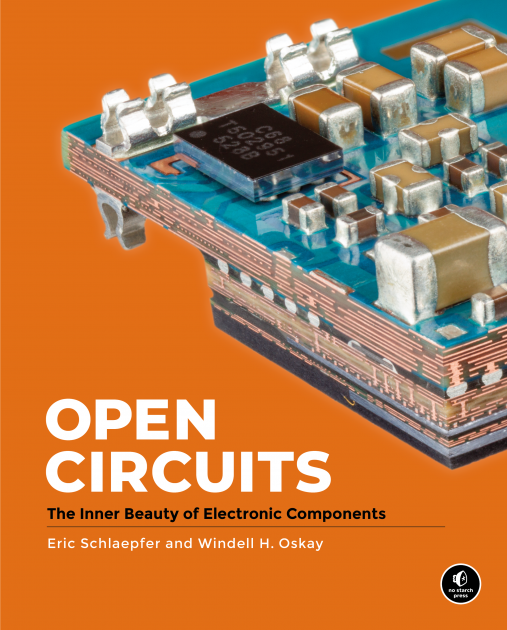
Aglow in our Author Spotlight series this month are the daring duo behind Open Circuits: The Inner Beauty of Electronic Components—Windell Oskay and Eric Schlaepfer. Their book is a truly unique photographic exploration of the astonishing design hiding in everyday electronics, and it's as awesome as it sounds. In the following Q&A, we talk with Eric and Windell about how this project came about, the ins and outs of the hardware disassembly and macro-photography feats it took to make the book, the surprises—both good and bad—that they encountered along the way, and the many challenges of cutting a cathode ray tube in two.


Eric is a hardware engineer at Google, and runs the popular Twitter account @TubeTimeUS, where he posts cross-section photos, discusses retrocomputing and reverse engineering, and investigates engineering accidents. His better-known projects are the MOnSter 6502 (the world’s largest 6502 microprocessor, made out of individual transistors) and the Snark Barker (a retro recreation of the famous Sound Blaster sound card).
Windell is the co-founder of Evil Mad Scientist Laboratories, where he designs robots and produces DIY and OS hardware "for art, education, and world domination.” A longtime photographer, he holds a B.A. in Physics and Mathematics from Lake Forest College and a Ph.D. in Physics from the University of Texas at Austin. Besides Open Circuits, he's author of The Annotated Build-It-Yourself Science Laboratory (Maker Media, 2015).
No Starch Press: First of all, congratulations on all the hard work paying off. The response to your book has been incredible. Considering how popular cross-section pictures were when I was a kid, I guess it’s not too surprising. People still love peeking into things full of hidden complexities! But the books I remember were mostly just intricate drawings—for Open Circuits, you actually photographed real stuff that you cut in half. What inspired this project? Did you intend to add a whole new dimension to the “cutaway” genre?
Eric Schlaepfer: I grew up fascinated by cross sections and cutaways. I’m sure that influenced this book, but it’s not exactly what inspired me. It was a broken piece of equipment, and the problem was one of the electrical components (a tantalum capacitor similar to the one on page 40). I sanded it in half to see if I could figure out how it failed, tweeted a photo, and folks really enjoyed it. So I started cutting other parts in half, and that led to the book.
Windell Oskay: I’ve always been interested in how things are made, in addition to how they work and what’s inside them. One of the really remarkable things about physically cutting things is that you get to see so many features that are maybe incidental to the function of the device, but are signatures of the processes that went into making it. Each part tells a story. And, often, we’re not even saying anything about them. Those little stories are left for the readers to discover.
NSP: The two of you have professionally intersected over the years in Silicon Valley, and have worked together on some design projects for Evil Mad Scientist Laboratories. But who roped whom into this book idea? What compelled you to collaborate at such a level?
ES: We’ve worked together on a number of other projects, such as the Three Fives discrete 555 timer kit, as well as the world’s largest 6502 microprocessor—the MOnSter 6502. Windell had seen my photos on Twitter, and we started talking about how to turn it into a book. I don’t remember all the details but it was a very natural thing.
WO: We’ve had a number of fruitful collaborations. In addition to those that Eric mentioned, we also designed an educational project, “Uncovering the Silicon,” that we presented at Maker Faire (along with Ken Shirriff, our technical reviewer for Open Circuits, and John McMaster, who prepared some subjects for photography). In that project, we placed very simple integrated circuits under a microscope and showed how they worked by tracing their individual parts. There’s a sense in which our book is a successor to that project—we’re letting people look at things up close, and then talking through how they work. But, I think that there was actually a moment when I roped Eric into the book idea after seeing his early cross-section photos.
NSP: What was the most challenging aspect of putting this book together?
ES: There were many challenges. For me, the most difficult challenge was preparing the samples—it took a really long time to prepare each one, taking care to create a polished section with no scratches or blemishes, and being careful to remove every speck of dust.
WO: At one point we realized that we would have to cull the weakest subjects from our draft. We ended up deleting about a dozen—some quite interesting and beautiful—along with their descriptive text. The book is stronger as a whole because we did so, but it really stung at the time. Fine-tuning our text was also difficult in places. For a number of subjects, we only had a few sentences in which to flesh out subtle concepts clearly, to an audience composed of both laypeople and engineers.
NSP: How did you divide up all of the labor that the book entailed? I mean, you had to find hundreds of tiny electronic components, carefully cut them in half, photograph them, write the accompanying text for each page—the list goes on and on!
ES: Windell took on the photography and some of the sample preparation, introducing me to some more professional tools that I hadn’t used before. We spent time searching the local electronics surplus store for potential subjects, and I made a lot of exploratory cuts to see if a particular component would be good enough for the book. I’d say the writing was a 50/50 split—we spent so much time writing and editing over video-chat that I wouldn’t be able to point to any sentence and definitively say 'I wrote this.'
WO: In addition to the bulk of the cutting and sample preparation, Eric also drew the rough drafts of all of the illustrations and wrote the initial drafts of some of the most challenging subjects to describe. I took the photographs, fine-tuned the illustrations, and designed the initial page layout so that we could understand how much text could be paired with each photographic subject. And as Eric said, we worked together closely through all of the writing and editorial choices.
NSP: Eric—what was the hardest thing to cross-section, and how did you eventually make it work?
ES: The most challenging was the cathode ray tube (page 186). Windell had the idea to cut it on the slow-speed saw so we could remove the electron gun. I sectioned the glass envelope and the electron gun separately—each of those took several hours to wet sand. The parts were simply too fragile to section any other way. Cleaning the sectioned electron gun was difficult because of the small magnet inside, which vacuumed up the debris created during sanding.
NSP: Windell—unlike a cross-section illustration, capturing everything inside an object with a single photograph in a single frame had to be difficult at times. Can you give us some examples where you had to get creative to get the shot?
WO: One of the basic limitations that you can run into with macro photography is the limited depth of field—only a very narrow slice of the view is in focus at any given time. We used focus-stacking software to digitally combine pictures taken at different camera positions, stitching them together like a panorama where the entire subject is sharp and in focus. The circuit-board photograph on the front cover of the book was taken this way. Other times, the subject itself can just be plain hard to photograph.
For some of the LEDs, like the surface-mount LED on page 90, we took photos at different exposure levels and composited them (in a basic HDR—high dynamic range—process) so that you can see detail even in the brightly lit LED. For the color sensor on page 81, the photos came out drab until we added an additional light source at just the right position and brightness so that you could see the additional reflection.
NSP: How did you decide what samples and images ultimately made it into the book?
ES: During endless hours of video chat we discussed every potential sample and made a highly detailed spreadsheet. We’re both very organized.
WO: Some part of it was determined by which things we could get our hands on—there are probably 50 other things in the spreadsheet that we might have included if we had an example to disassemble. We did skip a number of potential subjects that were too similar to others, too difficult to section, too difficult to photograph, or that were less likely to be of general interest.
NSP: Anyone who’s into photography knows that what’s pleasing to the eye is not always pleasing to the lens. Were there any samples that you successfully cross-sectioned but just could not get a good photo of—things you left on the cutting-room floor, as it were?
WO: Yes, there were quite a few actually, including some that we put a lot of time into preparing. A good example is a reed relay, where we just couldn’t get a photo that clearly showed the features that we wanted to highlight.
NSP: Given that you both have backgrounds in hardware engineering—and professional tinkering in general—did you know in advance which electronic components would look cool from a cross-cutting perspective, or was there a lot of trial and error? Any surprises along the way, good or bad?
ES: I’ve seen a few component cross sections created for failure-analysis purposes, so I knew about certain components that would look good, but there were definitely a few surprises. We thought an RGB LED would look cool, but after cutting into one, it just didn’t really seem interesting. We took apart a boring-looking gray electronics module that turned out to be a fabulously complex jewel—the isolation amplifier (page 266).
WO: One of my favorites that took some experimentation was the multilayer ceramic capacitor (page 36). There’s never been any mystery about what is in one—stacked layers of metal electrodes—but it took us a lot of experimentation and cutting into different capacitors to find one where you could literally see and count the individual layers. There were definitely real surprises along the way. The way that the rocker DIP switch (page 110) works inside is just stunning elegance.
NSP: You include a “Retro Tech” section in the book for your vintage finds, like Nixie tubes, a mercury tilt switch, and even a magnetic tape head. From a purely aesthetic standpoint, which era wins (Old vs. Modern) as far as microscale interior design goes?
ES: They both fascinate me. Vintage components seem warm and natural to me, being made of less processed materials like brass, rubber, mica, and glass. Modern parts have a sort of cold Cartesian precision and a microscopic intricacy.
WO: Modern electronics has so much more to offer in interior design—there’s just so much more inside. If we were talking about exterior design, I’ll pick the vintage. I love all the brass and Bakelite.
NSP: Windell, your company’s motto is “Making the World a Better Place, One Evil Mad Scientist at a Time.” If you had to come up with a similar motto for your book, what would it be? I’ll go first: “Making the garage a messier place, one experiment at a time!” . . . I guess what I’m getting at is, what effect do you hope your work in this book has on people? Eric, same question for you.
WO: If the book needed a motto, other than our existing subtitle, I’d pick “Showing you the Hidden Wonders Inside Electronics.” I hope that it inspires people to open up their electronics and look inside. To look at the parts for the little clues about how they’re made, what they’re for, and how they work. To appreciate elegant design, where they weren’t looking for it before.
ES: I want to inflame curiosity. Earlier today my very young nephew was totally absorbed in a copy of the book, asking his mother afterwards if they had any circuits he could play with. The world is a better place with curious people living in it.